Letters intercepted, plans foiled
The madness of the southern people

“The southern people are madder than the northern, tho’ I believe not such great rogues; they have got the highest pitch of raving madness,” South Carolina loyalist John Moultrie wrote to James Grant, a British general in Massachusetts. Moultrie’s letter traveled north with about a dozen others on the armed sloop Betsey, all entrusted to Moses Kirkland. His letter was short, Moultrie wrote, because “Kirkland will be better than a long letter.”
Lord William Campbell also trusted Kirkland to deliver messages orally. He wrote General Thomas Gage from his floating court in Charleston Harbor. Kirkland was “a man of great influence with” the backcountry loyalists, he wrote: “He has acquainted me with the particulars of the plan he means to communicate to your Excellency; and if the execution is not delayed too long, he may be useful in this and neighboring provinces.”
Neither Kirkland nor the letters he carried reached their destinations. The Betsey, laden with provisions for the army occupying Boston, was captured off the coast of Massachusetts, December 17, 1775, by captain John Manley on the Continental schooner Lee.

Manley imprisoned the crew of the Betsey and its Tory passengers and freed its American rebel prisoners. Its oats, Indian corn, and Irish potatoes went to fortify American troops. But the most valuable prize was the packet of letters from the royal governors of Virginia, South Carolina, and Florida, the Superintendent of Indian Affairs for the Southern District, and Kirkland. Five addressed generals of the British army in America. They revealed the writers’ contempt for the rebels, the plans they had to defeat them, and the weakness of the defenses of St. Augustine and Virginia.
The letters did reach the Continental Congress in Philadelphia, where they were subjected to a tug of war between the South Carolina delegates and everyone else. South Carolina lost, but its delegates came home with attested copies that the Timothy Printing Office published.
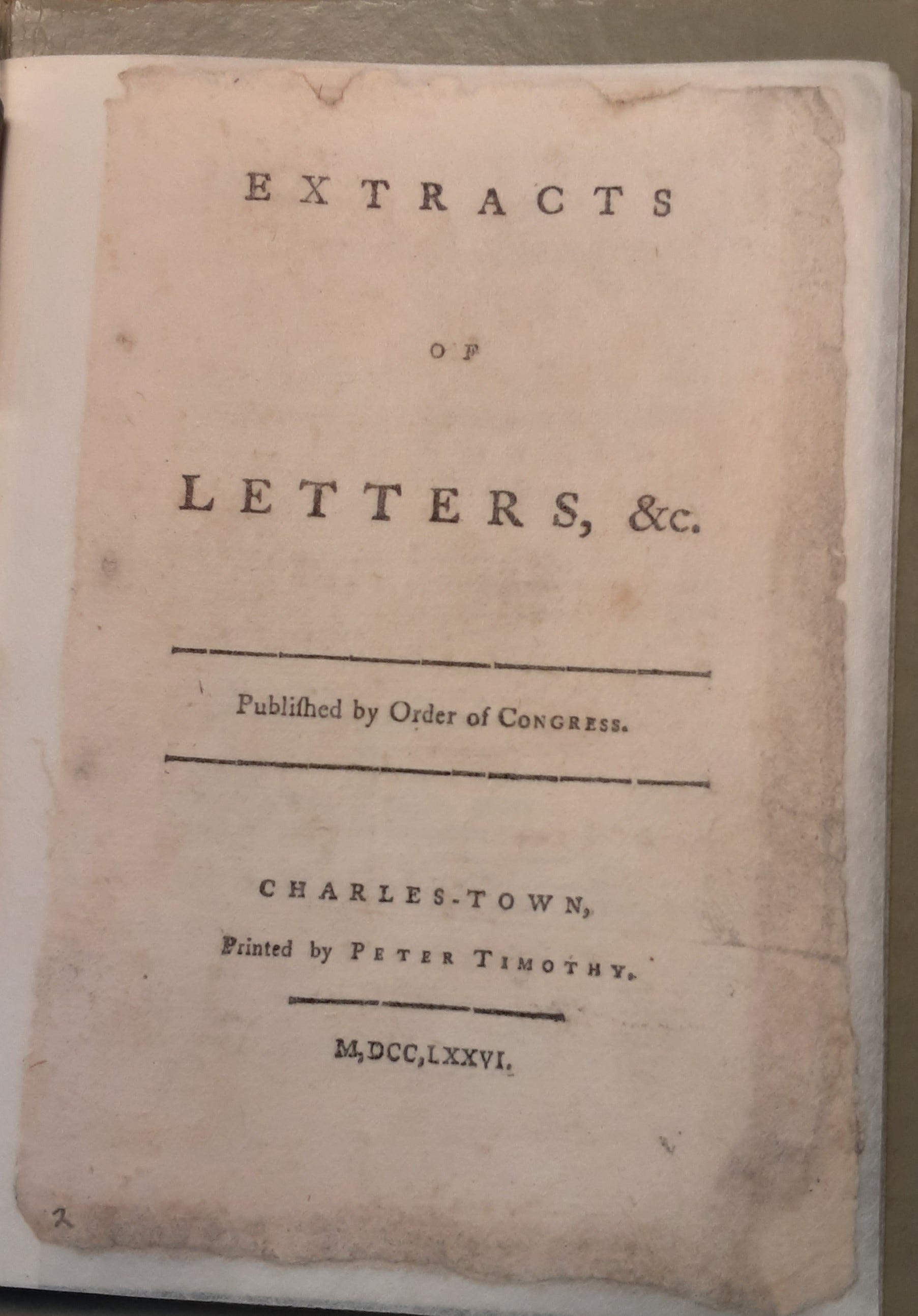
The print shop was far from idle after the last copy of the South-Carolina Gazette appeared in December. In addition to the Extract of Letters, &c., Published by Order of Congress, it printed the 137-page Extracts of the Journals of the Provincial Congress. Both publications circulated widely, so they must have entailed large print runs. In June of 1777 Peter Timothy, obviously proud of his work, mailed a set of the Journals to Benjamin Franklin in France.
The Provincial Congress acknowledged the value of the Timothy shop. In December it added £200 to the £2,000 annual salary allowed in July—it was paying him not to print the newspaper. The South-Carolina Gazette and Country Journal, run by Timothy’s former apprentice, had been supporting the American cause since the Stamp Act crisis. Timothy was more valuable as state printer, secretary, correspondent, and source of intelligence than as a newspaperman.
Three letters in the Extracts begged Gage not to deprive Florida of any more troops—as it was rumored he would do. The Florida governor wrote, “Should we be attacked it will be impossible to save the town or barracks.” A British major there wrote that the Virginia governor had detained troops destined for Florida, leaving him with only forty healthy men “at a season when the men are falling sick every day.”
Dunmore of Virginia recommended an attack on his region, touting its abundance of crops: “a winter Campaign would reduce, without the smallest doubt the whole of this southern Continent to a perfect state of obedience.”
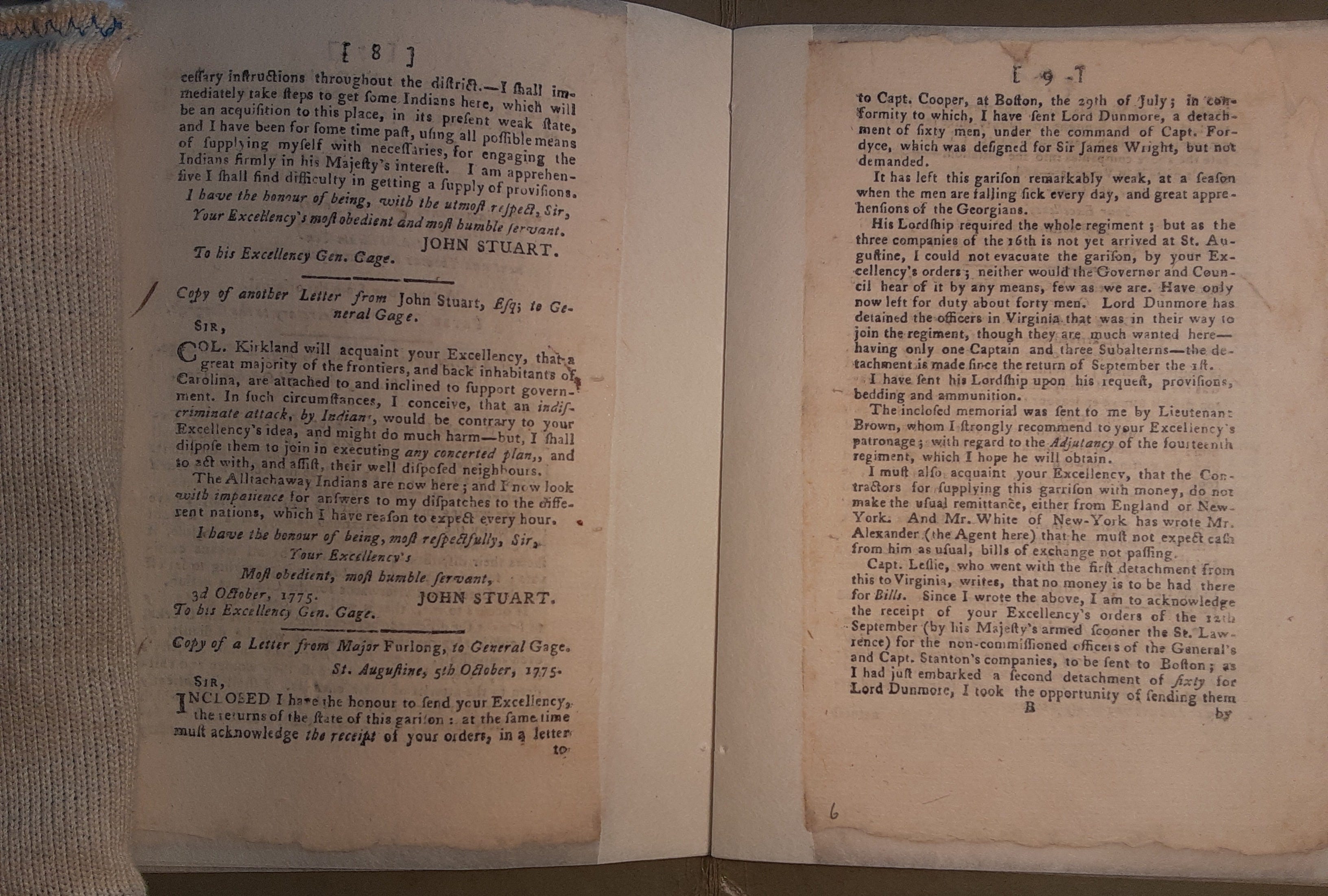
Nobody read those letters in time to do anything about them. At best they would have had to wait for Timothy’s Extract of Letters, &c. in early February 1776.
The loyalist John Moultrie was a brother of rebel Colonel William Moultrie, who led the assault on Fort Johnson and designed the half-moon flag of South Carolina. South Carolina’s Revolutionary War pitted brother against brother, just as the Civil War did eighty-four years later.
Our Memorial Day services here are sobering, especially in these times, as they give credit to those who were defending our country before it was a country. John Manley and Nicholson Broughton, skipper of the "Hannah," were johnny-come-latelies. The roll of honour, when properly done, includes those who fell in Queen Anne's War, 1711-1715. Deep roots in this town.
I love making these connections! I'd read than Manley had magnificent feats and exploits, but hadn't registered that he was a Marbleheader. Congrats on your amazing neighbor!