Unity forged and forced
The noblesse perfectly pacific

After South Carolina learned of the battle at Lexington and Concord, its Provincial Congress voted by a narrow margin to put the colony on a war footing. The Sons of Liberty went to work shoring up support. The South-Carolina Gazette did its part: on May 29 it printed a frontpage call to arms: “manly Actions should NOW take Place of unavailing Words.” The Massachusetts casualties were a gift to the propagandists.
“The designs of your Enemies are openly avowed” and were carried out “near Boston,” cried the Gazette. ““Let us resolve upon LIBERTY or DEATH and let us stand or fall together … the Risque may be great, but the Cause is Glorious.”
The second page of the May 29 Gazette printed a letter from London saying that Parliament intended to arm enslaved men, “the Roman Catholics, the Indians and Canadians; and [use] all the wicked means on earth to subdue the colonies.” That struck terror in the hearts of the white minority, but it was false.
The May 29 Gazette was the last for three months. The newspaper suffered as Peter Timothy went to work for several busy committees, but the Provincial Congress granted him a salary £1000, which more than compensated him for lost advertising revenue. As chairman of the Committee of Observation and Intelligence Timothy kept the names of the men who supported the Association formed by the Continental Congress. He was secretary to the General Committee, the revolutionary governing body, the Council of Safety, its department of defense, and the Secret Committee, whose main remit seems to have been stealing the King’s powder.
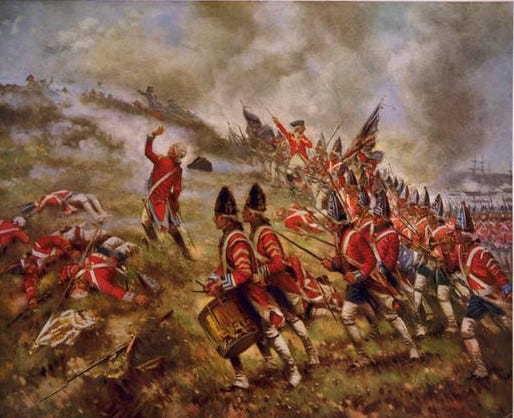
Coercion went hand in hand with propaganda. The General Committee required all white men to “certify” their support. Not everyone in Charleston was on board. The action “near Boston” helped with recruitment, but the Committee itself was wavering. In early May it postponed discussing a proposal to get all Inhabitants to sign an “association of defense.” The Council of Safety itself was divided between radicals who pushed for rapid militarization and moderates who feared war. Again, action near Boston helped. News in July that the British regulars “got a drubbing” at Bunker Hill moved things along, at least in Charleston.
The backcountry was another story. Settlers associated the royal government with protection from Indians and resented the arrogance of the revolutionaries. July 23 the Council of Safety sent William Henry Drayton and the Reverend William Tennent to preach the patriot gospel from Cheraw to Camden to Saxe-Gotha to Ninety Six and beyond.
In his many capacities and as brother in arms, Timothy wrote to Drayton what were essentially committee and council minutes, as well as news that would have made it into the Gazette.
On midnight August 13 he wrote “Business has gone on very slowly in the General Committee,” followed by a list of inconclusive actions, postponements, and matters taken into consideration. But Timothy had good news: The patriots captured 11,900 pounds of powder from an armed brigantine in St. Augustine, increasing the rebels’ stash to 21,000 pounds, five thousand of which was destined for Philadelphia to support the siege of Boston.
In other news, the gunner at Fort Johnson, which was still in British hands, had “a decent Tarring & Feathering for some insolent speech he had made.” The man was carted through the streets and before the doors of loyalists and British agents: “there was scarce a non-subscriber who did not tremble,” Timothy wrote. A mob of hundreds stripped the gunner before applying hot tar. He suffered two broken ribs in the attack and lost an eye. He was thrown into the river and nearly drowned before a passing boat rescued him. In his letter, Timothy merely mentioned that the loyalist printer, Wells, “had his Shop closed shut.”
He told Drayton that he “wish’d for you” when he read to the committee a resolution from the Second Continental Congress to purchase and arm ships. The reading “pleased us so well.” It was surely in the wee hours when Timothy closed: “’Tis difficult to keep up my Spirits.”
Three weeks later he wrote again under pressure, this time from hunger. “Altho’ my stomach bids me go, I can’t help staying in the Council Room” to report more successful acquisitions of powder being escorted to patriot hands “by artillery and grenadier Militia.”
Also, “yesterday the Comee of Observation stopp’d McLauren’s wagons” pending evidence that vendor and recipient “subscribed to the association” or else have their goods confiscated. The men scrambled and complied.
Timothy expected to spend the week preparing for elections to the next Provincial Congress. The moderate merchants had angled to get a quota of fifteen representatives, but had “at last condescended to be content with 10.”
“In regard to War and Peace,” he wrote, “I can only tell you that the Plebians are still for War—but the noblesse perfectly pacific—not like your chimerical Quixotical anti-pacificals, high admirals, & Associates.”
Fascinating. I note that whatever strategic value the early conflicts in New England had, they were propaganda gold for patriots in the other colonies.
When I worked on the Freedom Trail during the Bicentennial, my boss was a Briton. Whenever a tourist asked either of us if we had had an ancestor at Bunker Hill, we’d deadpan “If I did, he was wearing a red uniform.” You do a great job exploring the confusing lines of demarcation at this time.
As riveting as any series. The tension swells. Nicely presented.